|

|
|
| ||
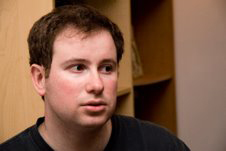
| about the author |
|
D.W. Speaking the language with grammar maimed and archaic, swollen with pronouns, turned to rubbish somewhere in the neighborhood of MLK boulevard, language of epic not magnitude, rather design, which descends either from Chaucer or Marlowe, speaking that language, he was to whisper or applause immune, indifferent to any rustle of footsteps diminishing across rectangular aisles, ready in verbiage, vers libre, prepared with an arse — nal of enjambments, metonymies — in general, diction, wistful to speak much more than he was to inspire, speaking that language, alluding to anti-inertia and something else, hardly visible, looming far-far in the distance, where space, as before, epitomized vowels, where, if howled, animals would at times disappear, speaking the language of changing decibels, only every now and then to pause and give rest to a fatigued ear. C.P. Cavafy Several decades spent in cafes were two thousand poems composed in yearning, ultimately trimmed to two or three hundred, simply signed "Cavafy." That's what distinguishes him from Seferis or Elytis. Second to none and Homer, he spent fewer sweaty nights in the fractured geography than the blind old man. He died before the great war, instead of describing it. And only then he began to matter. As a poet without metaphors. As a sympathizer of Julian. As what a young man means to another young man. That's the gist of him. The rest has been lost in cafes. Modigliani In 1910, Anna Andreevna would make an entrance and undress. Would then lie down on the couch and visibly elongate. Emerging as an isthmus between clay and sun's glow, the studio, en route to cobweb, would diminish in volume. He raved of Egypt, Verlaine, of cantos in Dante's Inferno and Paradise. Paced around Luxembourg Gardens, while counting steps and minutes in direction of Montparnasse. Thus, content unfolded, filling the vessel of an afternoon hour. Not a portraitist yet, he already despised landscapes. She would fathom this later, aging far beyond the age of his subjects. Older than el Greco-like waistlines and caryatid-inspired facial details. Life crowded him out with a host of subconscious ambitions. Shunning iterations, life replicated into faces. In terms of linguistics and further elements, the century remained still a nineteenth, amassing fatigue along sidewalks. In the twentieth, things would change: notably, mortality would. Mortality would arrive and have penury distracted, displaced. City's psyche would reject the nude. Reject sex. And Freud. Dadaism would emerge as a crown of Enlightenment and drivel. The future tense, however, is not as frail with the inevitable, as is secondary to the gaze that stares at things departed. The temporary processes Anna Andreevna was well versed in, marking in one's gaze an outgoing epoch. Winter Garden For J.M. Arbogast Hudson is split between the horizon and a tired gaze. Asbestos-dominated air widens to include objects of a windy evening. Boats are parked and useless. Insects look invisible. Trees are planted, like evidence. Thoughts lack torpor in darkness. This is New York. 200 Vesey St., New York, NY. Inside the glass of Winter Garden — rows of spectators, with Battleship Potemkin black and white on a big screen. Silent sailors in silent water. Silent devils — depicted, ominous, determined. The western eye captures what an eastern eye failed and, more importantly, — where it failed. And then there is corporate. Detached from Eisenstein, men and women in uniform, with Blackberries and Merrill badges — men and women rush downstairs to order evening dinner, having been ordered around throughout the day. They pass by Odessa's steps and elicit a gaze at kinetic darkness. They love their corporate jobs and march on forward. A tired writer visits the environs of this kind, or one who resembles a writer. "Evil, evil everywhere," he writes, blurring 1905 and 2005 toward unison. Shoulders shrugged, listless, bewildered, in part helpless, he stares into distances unknown. Like a blind Tiresias, who may be aware of the future, but laments that Oedipus is hardly aware of the past. Only to continue staring amidst darkness. October 25, 2010 There was a generic emptiness between the mirror on the wall and two eyelids on the face. There was nothing, except space, wistful to be filled with board games, Met paintings, walks in the Park, and items belonging to "etal." There was nothing that remotely contributed to movement. Neither a breath, nor a sigh. Nothing. Not even a mosquito in search of a yellow fever left a mark. Not even a fly did. Not even the dust belonging to "not even." It was a routine day They woke up that morning to Brahms' concerto. Nothing special: just Allegro non Troppo invading the privacy of ignorant ears. Not that ears matter. Of all the feelings that could have overwhelmed them — none did. It was a routine day, one that gets filled with non-classical movements, while sunlight persists amidst mundane, predictable weather, with Fahrenheit on the loose. It was a routine day. |
| © Copyright: Alexander Veytsman |

|